If you're an applied behavioral scientist, this probably sounds familiar: You're at a networking event, you introduce yourself, and you see a flicker in the other person's eyes. "Behavioral scientist? Oh, that's wonderful. My cousin is a behavioral analyst who works with kids." Or, more commonly, "So, you're like a therapist?"
This isn't just an amusing misunderstanding. It's a serious branding problem. In a field dedicated to understanding how people think and make decisions, it’s also deeply ironic.
In one brief moment, before you can bring up a compelling example of real behavioral science in action, a barrier has gone up. Your work has been instantly, and incorrectly, filed in the wrong mental folder. Instead of sharing illustrative examples, you’re spending precious time digging the conversation out of a conceptual pothole.
Many of us know that a brand narrative needs to communicate value, identity, and differentiation, and provide a foundation for customer or prospective client actions. Ambiguity at the starting gate leaves the listener uncertain about when, why, or how best to engage.
The Blueprint: Lessons from the Rise of UX
Solutions to behavioral science’s branding challenges don’t require reinventing the wheel. We can look at our closest cousin and common collaborator: User experience (UX).
Decades ago, "UX" didn't exist as a business function. It lived in academia as "human-computer interaction" (HCI), a technical, complex field. But in the early ‘90s, Don Norman, a cognitive scientist at Apple, coined the phrase "user experience" because he knew the work was about more than just the computer—it was about the total experience a person has with any product.
The UX reframe unlocked something essential: It provided a new mental model for business leaders. They might not have understood HCI (can you remember what it stands for?) but they intuitively understood the value of a user’s "experience."
This shift was a major step towards UX practitioners connecting their work to businesses’ return on investment (ROI). Good user experience wasn't a soft metric—prioritizing it often led to higher conversion rates, increased customer loyalty, lower churn, and lower support costs.
Such crystal-clear value propositions led to the creation of UX design and research roles, dedicated teams, and—crucially—dedicated budget lines.
UX won the boardroom because it started speaking the language of business. Behavioral science practitioners can do the same by leading with what's in it for the company and its bottom line. Focusing on process and rationale too early bypasses the fleeting chance to invoke an "Ah-ha!" moment. Bridging this language gap is critical if we want our work to become standard business practice.

Consider this analogy: If you speak English but want to work with someone who grew up speaking French, the onus is on you to learn French. Neither of you is less intelligent, you just speak different languages. The responsibility to bridge that gap sits with whoever most wants the collaboration to happen, which, in many cases, is us.
This matters more often than you might think, because the decision to use behavioral science is almost never made while you're in the room. Your internal champion or prospective client has to carry your message to their boss, their colleagues, the budget committee, and any other stakeholders involved. Set them, and yourself, up for success by speaking their language and making it easy. Most of us would struggle to sell on behalf of a quantum physicist after watching them present an academic poster. You’d want them to break down their work in terms you could understand and explain, and your stakeholders won't be comfortable selling your science without that same support.
Our skill in translating behavioral science to business priorities deserves greater prioritization in the behavioral scientist's toolkit. Applied behavioral science is ready for its own UX moment: A linguistic on-ramp that connects our value to the priorities of our public and private sector partners.
The most pragmatic move is to adopt context-specific names. "User behavior" (UB) is a strong candidate. It connects our discipline to what businesses, NGOs, and governments already understand, value, and fund: Users.
The pitch becomes simple:
"You know that user experience and user research you already invest in? We're a missing piece of that puzzle."
The same logic extends to "customer behavior" and "patient behavior" in other applied contexts. This reframes our discipline from abstract science to concrete strategic function. It's a language built to travel into the rooms where decisions get made.

The "Why" to UX's "How"
User behavior doesn't replace user experience; it supercharges it.
UX research may already ask why users behave the way they do. What user behavior brings is a laser focus on a user's specific decisions and choices, which link directly to ROI.
Where UX maps the experience and surfaces the friction, UB explains the underlying mechanisms—the cognitive, emotional, and social drivers that determine whether a behavior happens at all.
Why are users dropping off at this step and not the previous one?
Why are they choosing the default option even when a better one is available?
Why do they say one thing in interviews and do something else in the product?
Take a UX team that has identified users abandoning a subscription form. A UB specialist can diagnose why it's happening—perhaps the psychological friction of choice overload, or ambiguous language that triggers regret aversion—and then design a behaviorally informed A/B test to improve results. Our questions may overlap with UX's, but the methods and models for answering them are distinctive.
Think of it with this simple formula:
UX-Designs the Experience + UB (User Behavior) Drives the Decisions = Measurable ROI
This partnership turns product development from guesswork into applied science, often with measurable gains. And we’ve seen it happen with:
- Retirement savings. Intuit increased the share of new employees saving for emergencies fivefold, from 3% at baseline, by adding a single behaviorally-informed prompt at payroll setup asking employees to "save when they get paid" (Irrational Labs, 2026).
- Energy costs. Facility managers receiving AI-timed prompts to adjust thermostats and run heavy machinery during off-peak hours cut peak energy use by 42%, saving an average of $230,000 per year (Amaral et al., 2024).
- Vaccination uptake. Pre-assigning COVID-19 vaccination appointments instead of asking people to schedule their own raised attendance by 32% (Tentori et al., 2022).
In each case, the behavioral mechanisms are doing the work: Defaults, friction reduction, and well-timed cues at key leverage points. UX can surface what needs to change. UB explains why a particular change will move a behavior.
A proposal for improving our branding: Have you used these terms in various applied contexts?
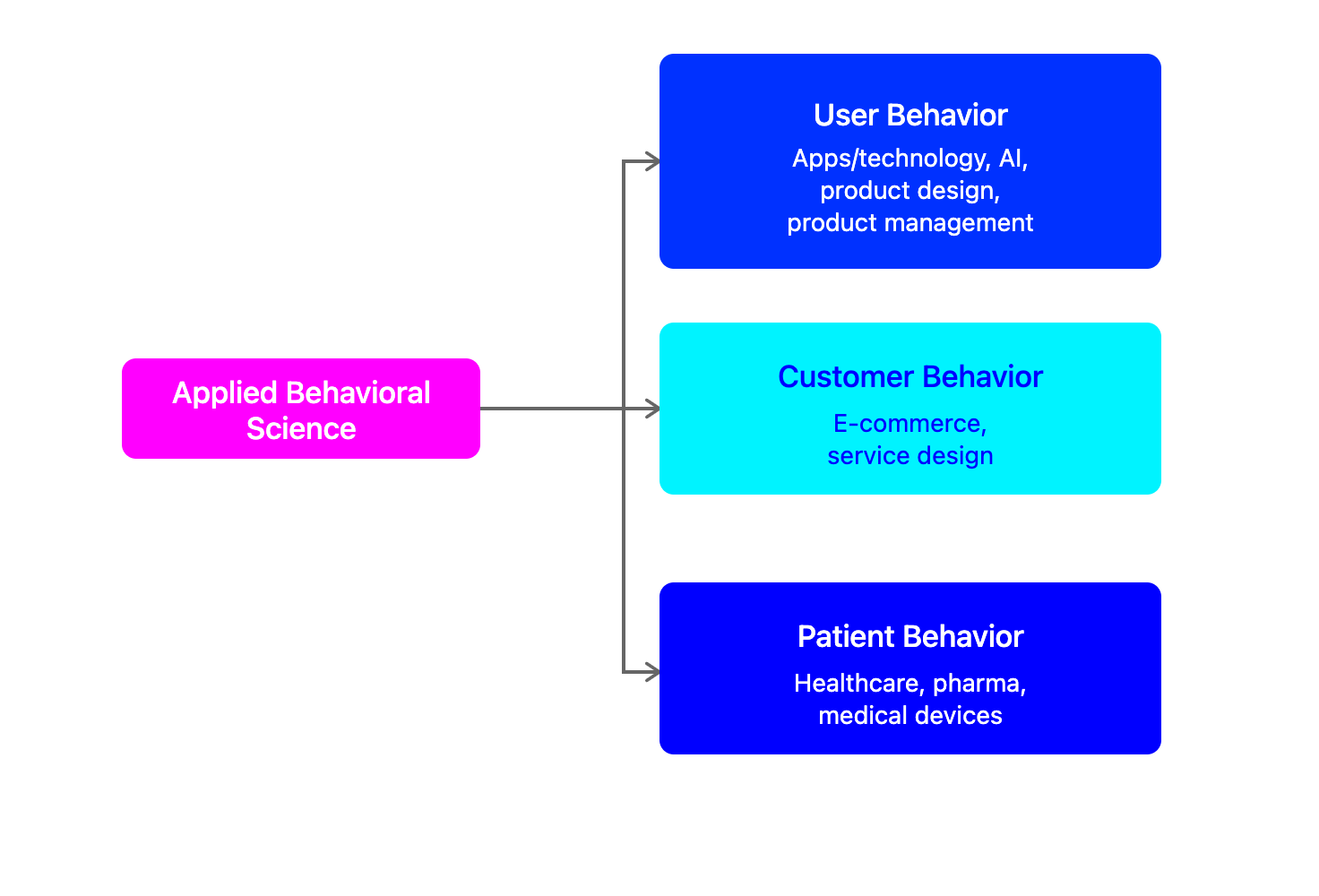
Naming the field is one level of this work, and it's a long conversation. There's a second level that's more immediate and within every practitioner's control: How we describe individual engagements, projects, and value propositions in the language of the people we're trying to persuade.
You can start that today.
Putting “Translation” into Practice
Here are two examples of how you might “translate” your behavioral science perspective into business language.
- Traditional framing: "I use behavioral science to help pharma sales teams by applying frameworks like COM-B and motivational interviewing to understand HCP decision-making patterns."
Translation: “Your reps are leaving conversations without moving the needle, and your brand is starting to fall behind your competitors. I help your reps understand what's actually driving physician behavior so they can have conversations that change prescription rates, not just inform and educate.” - Traditional framing: "I'm proposing a behavioral science-informed intervention using implementation intentions and social norms to address the low adoption rate of our new performance management system”
Translation: "Only 30% of managers are using the new performance system, and it's starting to show in our retention numbers. I know how to find out why they're not using it, and I know how to fix it without another training they'll ignore.”
This shift in communication approach doesn’t just benefit applied behavioral scientists trying to win a job or project in industry.
By making our language more accessible to non-specialists, we also improve the likelihood that our academic counterparts’ work gets the acknowledgement that it deserves and increase opportunities for funding research and building industry partnerships.
Adjusting the way we talk about our field may even lead more young people to choose to study the social sciences and see its potential beyond positions with “behavioral science” in the title. A rising tide lifts all ships.
Let’s Have the Conversation
The name we use for our field matters. It shapes how we are perceived, how our value is understood, and whether we get a seat at the table. "Behavioral science" invites confusion. It's time to stop explaining that we're not therapists and start showing how we can be essential, valuable players on product and service teams. We've offered a few options here, such as user behavior, customer behavior, and patient behavior.
Would any of these travel well with your stakeholders?
What other terms do you use to communicate applied behavioral science's core value?
The need to improve our branding is clear. The open question is what language lands best, not just for us, but for the stakeholders we need to reach most.