Some people have told me that I have an annoying habit of shrugging my shoulders at things that make them furious. I’ve run start-up businesses before and survival is a day-to-day struggle that can occasionally test your morals and ethics. So when someone shows me a headline about a company gaming its own metrics to win business, I don’t get upset, I get it.
That’s roughly how I felt the first time I really sat with the data on THC percentages. It was actually a big part of what inspired me to go back to school and get my Master’s in Behavioral and Decision Sciences at the University of Pennsylvania. What I was seeing was an old behavioral economics problem in a distinctive setting. It deserved a name: THC % Bias.
In short, if you are a consumer in the legal cannabis market in the US, you’re probably weighting THC percentage more heavily than it deserves. In part, because it’s a number the market taught you to trust, giving market operators strong incentives to keep inflating it. In part, because even an honest version of that number wouldn’t predict your actual experience nearly as well as you assume.
First, let’s define THC % Bias
Behavioral science already has a name for the broader phenomenon at work here. It can be called number bias or quantification bias. It is the thing that happens whenever people are faced with a difficult decision, and they replace performing complex analyses with evaluating a single calculated figure to simplify the decision.[1] Think of a car’s horsepower rating standing in for how it’ll feel to drive.
None of these numbers are meaningless, but they all only tell a small portion of the whole story. The moment a number becomes the thing people use to decide what to buy, hire, fund, or admit, someone downstream has a very strong incentive to move the number rather than move the underlying reality. The number a buyer trusts most is the number most worth manipulating.
THC % Bias is the tendency to treat lab-reported THC % as a reliable stand-in for quality, strength, and value of cannabis products.
How high can the number go—and what does it tell you?
Cannabis flower has a practical biological limit to how much of its dry weight can consist of THC. A 2025 University of Colorado CU Boulder (CU Boulder) audit of 277 dispensary-bought products found labeled flower potency claimed as high as 39.0%, while the highest value the lab actually measured, across every sample, was 33.0%.[10]
More importantly, even a perfectly accurate THC percentage does not tell you how high you are going to feel. In a CU Boulder study led by Cinnamon Bidwell, concentrate users reached blood THC levels roughly twice those of flower users. Despite that difference, researchers found remarkably similar self-reported intoxication, balance, and cognitive impairment between the groups.[11] THC is a partial agonist at CB1 receptors. Even at high concentrations, it does not produce an unlimited increase in receptor response.[12] Like horsepower, the number matters. It just doesn’t carry the whole experience.
Goodhart’s Law, cannabis edition
Goodhart’s Law states that “when a measure becomes a target, it ceases to be a good measure.”[2] But before assigning blame, it’s worth resisting the easy version of this story: a chain of villains. Much of it is a chain of people responding to the market signals in front of them.
At the retail counter, all products are kept securely in strict packaging, so it is impossible for consumers to factor in “look and feel” metrics to differentiate products. Facing decision overload, they are motivated to search for an alternative metric to help them make up their mind. In this confusion, consumers and operators informally agreed that a higher THC% number means a better product.
Retailers respond to what sells. Growers respond to what retailers buy. Trade press has documented growers who describe feeling “trapped chasing numbers just to stay on the shelves.”[3] Anecdotally, a cultivator in NJ told me directly that some of his business-to-business supply contracts are written with THC-percentage minimums baked in.
As a result, cultivators and manufacturers are remarkably unabashed when they demand higher results from their lab partner. Nobody has to be the villain for the pressure to build all the way up the chain, which is precisely the signature of Goodhart’s Law. But pressure isn’t permission. Operators may be responding to market incentives, but labs remain responsible for reporting what they measure. They are the last checkpoint between the plant and the label.
Labs face a prisoner’s dilemma. If everyone reports honestly, the market gets a number it can trust. But each lab faces a different calculation.
If competitors stay honest, inflating THC percentages wins clients. If competitors inflate THC percentages, staying honest risks watching clients walk out the door. When every lab follows that incentive, trust erodes without a lasting competitive advantage.
A large multi-state pricing analysis covering more than 710,000 flower listings found that moving a label from 20% to 30% THC raises the price of a gram by roughly 8.5%. A grower who genuinely earns 30% has paid for the genetics, the inputs, and the risk to capture a 8.5% premium. A lab that simply reports 30% captures the same 8.5% premium for free.[4]
For quantification bias to lead to Goodhart’s law in the wild, the market needs four typical ingredients:
1. A single, easily quantified proxy standing in for a complex decision;
2. That proxy tied directly to price or status;
3. No standardized, audited method for producing the number; and
4. The party being measured gets to choose and pay whoever measures them.
THC % currently checks all four boxes, which creates the feedback loop necessary to perpetually drive numbers higher and higher.
Market Signals: What we see in the wild
In late 2023, MJBizDaily obtained an independent statistical analysis, conducted by a data scientist at a Massachusetts testing lab, of nearly 400,000 flower samples processed by 70 labs across four states. Some labs’ results clustered around round numbers, and some averaged roughly 25% higher than competitors testing the same flower.[5] In Massachusetts, a lab representative told a Boston Globe source, on the record, “What test results do you need from us in order to keep your business?”
A blinded study out of Colorado makes the same point without any statistical inference required at all. One sample, split and sent blind to six of Colorado’s seven licensed labs, scored anywhere from 15.8% to 22.8% depending on which lab opened the bag, and a sample resubmitted to the same lab on different days ranged from 17.9% to 22.8%.[5]
The courts are starting to weigh in, too. In a 2022–2023 California class action over a brand’s pre-rolls labeled as high as 46% THC that independent testing found closer to half that, the court rejected the company’s “the lab told us so” defense outright.[6]
Show me the receipts
A natural biological measurement doesn’t know what a legal limit is, and it doesn’t prefer round numbers. What you’re about to see behaves in another way entirely:
Fingerprint one: a number that hits a wall
The state of Mississippi has a hard statutory cap on flower potency: no product may be sold above 30% total THC.[7] I fit a smooth expected distribution to each facility’s below-cutoff results, aka the curve biology would produce if results were truly random, and compared it to what the labs actually reported.
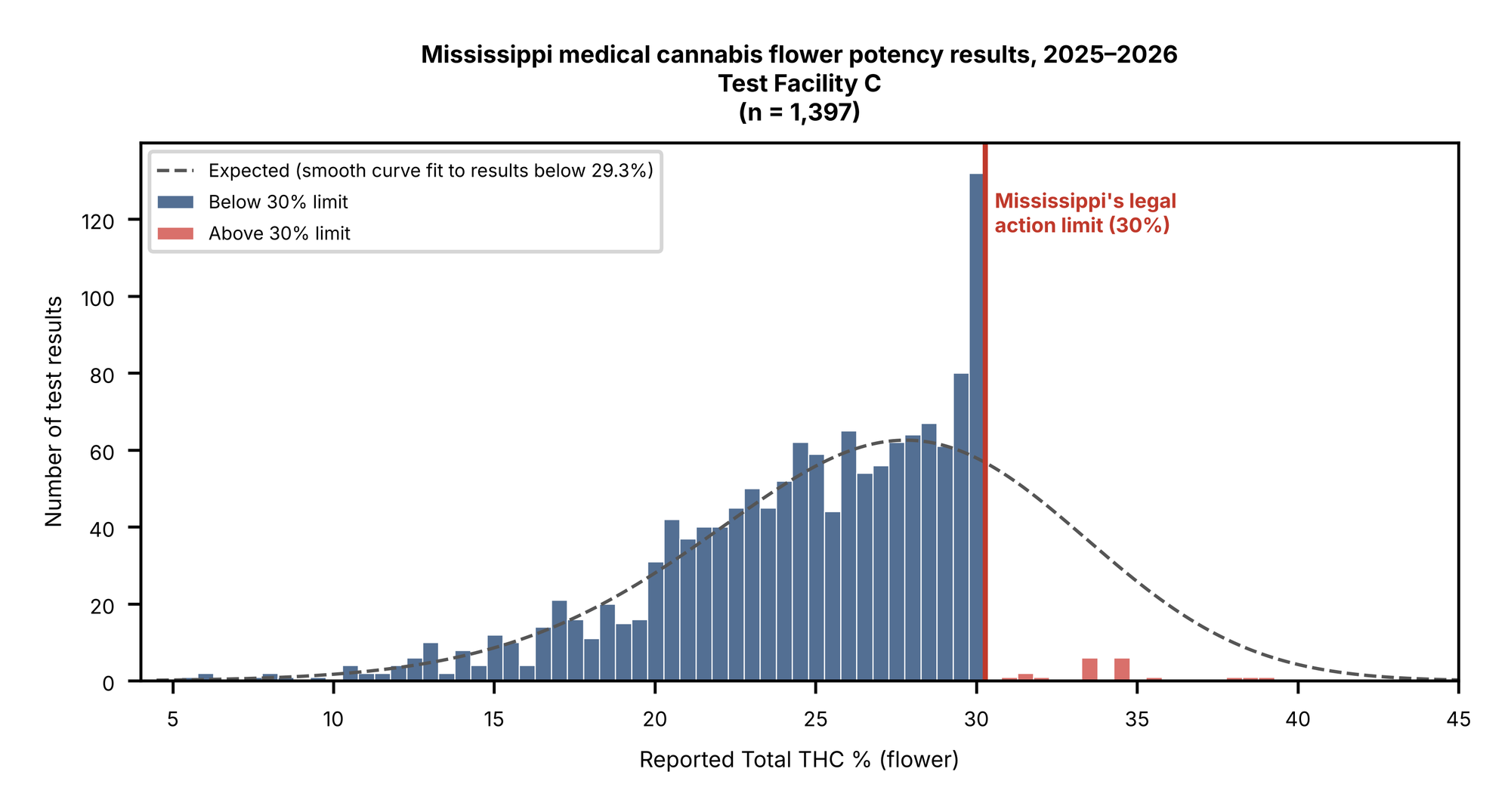
At Test Facility C, in the single half-point band just under the cutoff, actual results spike to more than double what the smooth curve predicts. The next band, just above 30%, should still carry a meaningful share of results if nothing were being managed and instead it’s almost empty. A biological measurement has no reason to recognize a legal cutoff. Instead, the data develop sharp patterns exactly where the law draws the line.
Fingerprint two: before and after regulators stepped in
Massachusetts suspended a testing lab, we will call them Lab Y, in July 2025, after regulators found the lab had been reporting a yeast-and-mold failure rate roughly 90 times lower than the state average. Using the Commonwealth’s own published testing records, I pulled every flower sample Lab Y tested before the suspension and every one it’s tested since resuming operations.[8]

Before the suspension, we see 9,855 flower results, averaging 24.3% THC, and after reinstatement, we see 456 results, averaging 20.6% representing a drop of 3.8 percentage points (p < 0.001, Cohen’s d of 0.77). The lab went from testing roughly 385 flower samples a week before the suspension to about 46 a week after, an 88% drop. That’s corroborating evidence that a lab that lost most of its client base after getting caught is exactly what you’d expect if the numbers had been what won them the business in the first place.
Fingerprint three: the whole market moved
Averaged across five major New Jersey testing labs every quarter from January 2023 through February 2026, flower Total THC climbed from 20.9% to 26.4%.[9]
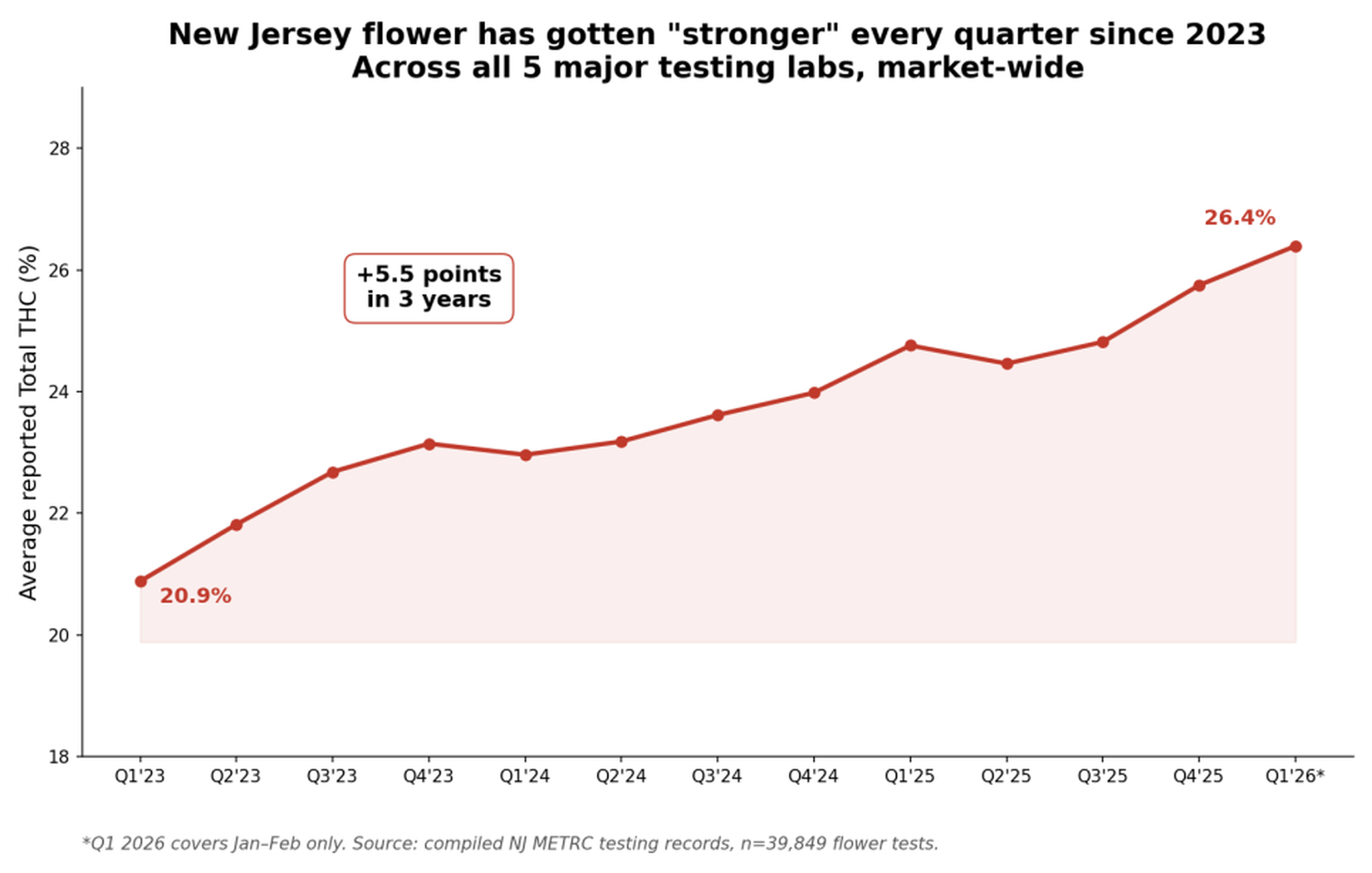
Genetics alone doesn’t do this. Breeding takes years to move a strain’s ceiling meaningfully, and it doesn’t move an entire regional market’s average up by a quarter of its own starting value in three years, in lockstep, across five competing labs at once. What does move a whole market that fast, in the same direction, all together, is a shared incentive that every lab and every cultivator is responding to.
Fingerprint four: A brand’s results rise after switching labs
Operator X, a New Jersey flower brand, tested exclusively with Lab A from January 2023 through October 20, 2024. Its 1,543 results averaged 21.3% THC. Testing switched to Lab B the next day; its subsequent 974 results averaged 25.6%.[9]

The unnatural bunching, gaps, market-wide creep, and same-day jumps are not absolute proof of manipulation and bad behavior, but these phenomena do not naturally arise from healthy, unmanaged measurement of THC%.
What does this mean for consumers?
I’m not telling you high-THC products are dangerous, or that you’ve been personally victimized every time you bought any. I’m telling you the number driving that decision is close to meaningless for two key reasons:
- Market incentives and documented testing problems give you good reason not to treat every reported percentage as gospel, and
- Even a perfectly precise THC percentage wouldn’t predict your experience as well as the market has taught you to assume.
Use THC percentage as one signal alongside your own memory of what you liked last time. A number can help you choose. Let it make the whole decision, though, and you’re giving Goodhart’s Law a very comfortable seat at the counter. If you’re a consumer and want a better purchasing signal, your own memory of what you liked last time will tell you more than the THC% number ever will. It can help with the decision, but the more importance we place on that single number, the greater the incentive is to manipulate it.
References
[1] Chang, Linda W., Erika L. Kirgios, Sendhil Mullainathan, and Katherine L. Milkman. “Does Counting Change What Counts? Quantification Fixation Biases Decision-Making.” Proceedings of the National Academy of Sciences, vol. 121, no. 46, 2024, e2400215121.
[2] Goodhart, Charles A. E. “Problems of Monetary Management: The U.K. Experience.” Papers in Monetary Economics, Reserve Bank of Australia, 1975.
[3] “Is the THC % Game Rigged?” High Times. Accessed July 30, 2026.
[4] Han, Bing, and Yuyan Shi. “Multilevel Determinants of Cannabis Prices in Legal Markets: Evidence from Products Sold in Nearly 4,000 Cannabis Dispensaries in the United States.” International Journal of Drug Policy, 2025, doi.org/10.1016/j.drugpo.2025.104722.
[5] Roberts, Chris. “Marijuana Lab-Testing Analysis Finds Routine THC Inflation, Data Manipulation.” MJBizDaily, 2023. Kohli, Diti, and Scooty Nickerson. “How a ‘Well-Known Secret’ in Massachusetts Cannabis Testing Is Obscuring What’s in Your Weed.” The Boston Globe, 27 Sept. 2024. Lavin, Kate. “Colorado Cannabis Operator’s Testing Experiment Yields Damning Pesticide, Microbial and Potency Results.” MJBizDaily, 3 Feb. 2025. Roberts, Chris. “Study: Colorado Cannabis Labs Produce Unreliable THC Potency Results.” MJBizDaily, 4 Nov. 2025.
[6] Class action concerning THC labeling of pre-roll products, Los Angeles County Superior Court, June 2023 ruling on demurrer.
[7] Original analysis by the author using Mississippi State Department of Health cannabis testing records obtained through a public-records request (production dated March 19, 2026; records covering 2023–2026). Mississippi’s 30% flower-potency limit is codified at Miss. Code Ann. § 41-137-39.
[8] Original analysis by the author using Massachusetts Cannabis Control Commission open testing-result data, including “Testing_Results_2024_20260415_OpenData.csv” and “CCC_Testing_Results_2025.csv.”
[9] Original analysis by the author using a compiled dataset of 82,472 New Jersey cannabis laboratory results from January 2023 through February 2026, assembled from publicly available testing records.
[10] Giordano, Gregory, et al. “Accuracy of Labeled THC Potency across Flower and Concentrate Cannabis Products.” Scientific Reports, vol. 15, article 20822, 2025, doi.org/10.1038/s41598-025-03854-3.
[11] Bidwell, L. Cinnamon, et al. “Acute Objective and Subjective Intoxication Effects of Legal-Market High Potency THC-Dominant versus CBD-Dominant Cannabis Concentrates.” Scientific Reports 11 (2021): 8506.
[12] Pertwee, Roger G. “The Diverse CB1 and CB2 Receptor Pharmacology of Three Plant Cannabinoids: Δ9-Tetrahydrocannabinol, Cannabidiol and Δ9-Tetrahydrocannabivarin.” British Journal of Pharmacology 153, no. 2 (2008): 199–215.