What happens when a behavioral science community tries to use behavioral science on itself? Bescy Philadelphia has been asking these questions as we work to slowly broaden our community.
There is an old saying that the cobbler's children have no shoes, and maybe behavioral scientists have a version of the same problem. We spend our professional lives thinking about behavior: why people do what they do, why intentions fail to translate into action, how environments shape choices, how social norms influence us, and why seemingly small barriers can have surprisingly large effects.
And then we organize a professional event, send out an invitation, and wonder why more people didn't come.
At Bescy Philadelphia, we've been thinking about that contradiction quite a bit. Our chapter has a strong foundation, particularly through our connection with the University of Pennsylvania and students from Penn's Master of Behavioral and Decision Sciences (MBDS) program. But we have also been asking ourselves a broader question: What would it take to build a behavioral science community in Philadelphia that extends beyond one university, one career stage, or even one definition of a "behavioral scientist"?
We wanted more students from universities across the region. More practitioners applying behavioral science inside companies. More people working in research, insights, UX, design, policy, healthcare, marketing, innovation, and other adjacent spaces. More people who may be using behavioral science without necessarily putting “behavioral scientist” on their LinkedIn profile.
And we wanted those people to not only attend an event once, but to feel that this is their community too, joining us again and again. We wanted familiar faces.
Our approach so far has been decidedly unflashy. We are not trying to dramatically increase membership overnight or fill a room for one big event and call that growth. Instead, we have been thinking about what it actually takes for a professional community to develop over time: for someone to hear about an event, decide it feels worth attending, show up without knowing many people, have a good enough experience to return, and eventually begin to see themselves as part of the group.
That kind of growth is necessarily slower, but it is also where behavioral science becomes particularly useful. Because when we talk about “growing a community,” what we are really talking about is a series of behaviors. People have to discover the group, attend something for the first time, introduce themselves to someone they do not know, come back a second time, bring a colleague or classmate, share an idea, or eventually take a more active role themselves. None of those behaviors happens simply because we have added another name to a mailing list.
And that has made us reconsider what community engagement actually means. It is tempting to treat growth primarily as an awareness problem; if more people knew Bescy Philadelphia existed, surely more people would participate.
And we tried that. We posted on all the socials (and of course LinkedIn). We reached out personally to all the local universities (and the Philadelphia area is blessed with over 80 postsecondary institutions!).
So our question has gradually shifted from “How do we get more people to know about Bescy Philadelphia?” to “What makes it easier for someone to become part of a community?” Awareness is only one part of the behavioral equation. Decades of research on the intention-behavior gap show that even fairly strong intentions do not reliably translate into action (Sheeran & Webb, 2016). Seemingly small costs or barriers can make it harder for people to follow through on something they otherwise want to do (Shahab & Lades, 2021). Those frictions may not be complicated forms or bureaucratic processes, but much more ordinary: uncertainty about what an event will be like, not knowing anyone there, wondering whether you have enough expertise to belong, or simply having to make one more decision at the end of a long workday.
In other words, community isn't really an outcome. It is a collection of behaviors. Recognizing that distinction meaningfully changes the problem. Rather than asking only how we get more members, we have started thinking about the smaller behaviors that eventually produce a community: what makes someone decide to show up in the first place, what makes that first experience feel less intimidating, and what gives them a reason to return. We also have to think about how people who would not normally encounter one another become connected, how an attendee eventually becomes a participant or contributor, and what signals tell a newcomer that people like them belong here too.
Those questions have gradually become the basis for how we think about growth in Philadelphia. And so we start by lowering the threshold.
A behavioral-driven approach to community growth
One of our “experiments” on behavioral-driven self-improvement has been purposefully low-tech and simple: the Stammtisch, a German word that refers to a regular table or gathering place for a group of people. There is no elaborate agenda, no keynote speaker, and no expectation that attendees arrive ready to "network" their way around a room (Wikipedia contributors, 2025).
We meet. We have a drink or something to eat. We talk about behavioral science, work, careers, research, and usually plenty of things that have nothing to do with behavioral science at all.
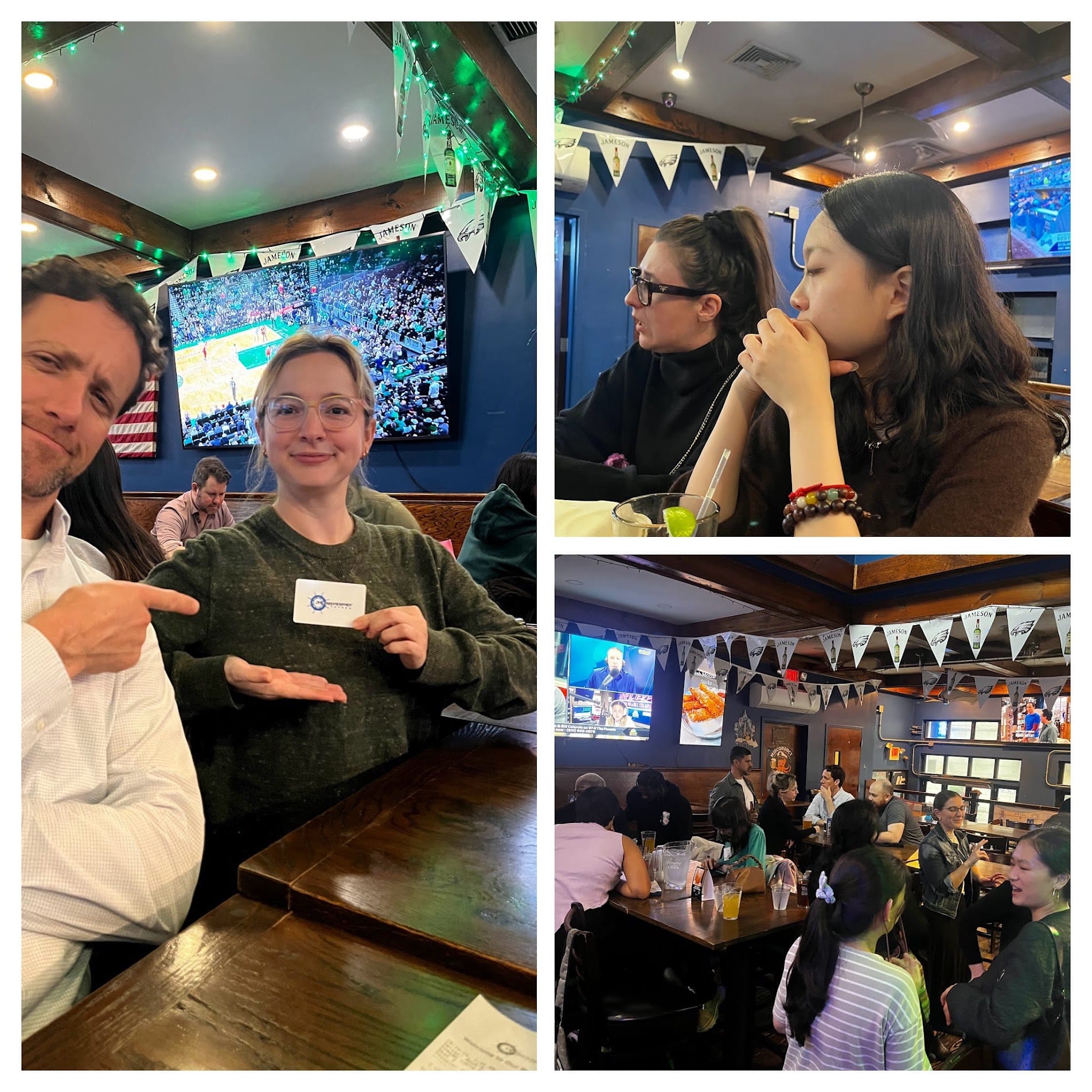
At a recent Philly Bescy Stammtisch, for example, a casual conversation about recent travel led me to mention a conference I had attended and a presentation on organoid research. Before long, we were having a surprisingly animated discussion about “cells in a dish playing video games,” biological learning, and what any of that might mean for intelligence or consciousness (Kagan, et al., 2022). It wasn't a planned topic, or even specifically a behavioral science conversation. But that is part of the value of these gatherings: engagement does not always need to be programmed. Sometimes creating the conditions for interesting people to talk to one another is enough for curiosity, connection, and intellectual exchange to emerge on their own.
This informality is part of the intervention and becomes part of the fun of belonging.
Traditional professional events can carry surprisingly high behavioral costs. You need to decide whether the event is worth your evening, register, travel there, perhaps prepare something intelligent to say, enter a room of strangers, figure out whom to approach, and engage in that peculiar professional ritual we call networking.
Each step introduces friction. A casual recurring gathering like a Stammtisch lowers the stakes. There is less to prepare for, less pressure to perform, and fewer assumptions about what "successful attendance" should look like. It also gives us something behavioral scientists know is incredibly valuable: repetition.
Familiarity matters. Zajonc's classic work on the mere-exposure effect demonstrated that repeated exposure can increase positive affect toward initially neutral stimuli (Zajonc, 1968). Not that the mere-exposure literature allows us to claim that repeatedly seeing the same behavioral scientists in a pub will somehow automatically make everyone best friends. But the underlying idea is useful: unfamiliar things can become easier and more comfortable with repeated contact.
The first Bescy event someone attends may feel a little like entering someone else’s network. In fact, that was the experience of one of us at her first event. It was held behind a locked door on Penn’s campus, requiring a slightly awkward slip inside behind a student, only to enter a room filled with faculty and students who clearly already knew one another. It was daunting, and despite an interest in behavioral science and a desire to be there, it wasn’t immediately obvious that this was a community where she belonged. A first Stammtisch can carry some of that same uncertainty: Who will be there? Will everyone already know one another? Will I have someone to talk to? Am I really part of this group?
These small moments matter because people are constantly reading social environments for cues about whether they fit. Research on belonging uncertainty suggests that uncertainty about one’s social fit can shape how ambiguous experiences are interpreted and whether people continue to engage (Walton & Cohen, 2011).
But by the third or fourth event, there are recognizable faces. Eventually, it can start to feel like your network. If we want diversity, we have to design for it. There is another challenge, though.
Communities naturally reproduce themselves. Social network research has long documented a concept called homophily, our tendency to form relationships with people who are similar to ourselves. As McPherson, Smith-Lovin, and Cook famously summarized it, "similarity breeds connection" (McPherson et al., 2001). And that makes intuitive sense. Existing members invite people they know. Students invite classmates. Academics invite academics. Industry people invite colleagues.
There is nothing malicious about that process. In fact, it is remarkably efficient. But, it is also exactly how a community can unintentionally remain relatively homogeneous.
If most of the people attending an event come from one program or one professional network, a newcomer walking into the room receives an immediate social signal about who the group is for. The existing community becomes the descriptive norm. That means simply saying "everyone is welcome" isn't necessarily enough.
If we want a more diverse community, we need to alter the pathways through which people enter it.
For Bescy Philadelphia, that means deliberately reaching beyond our existing networks: inviting students from other universities, connecting with people in industry and applied research, and designing events around topics that appeal to practitioners who might not otherwise see themselves as part of a behavioral science organization.
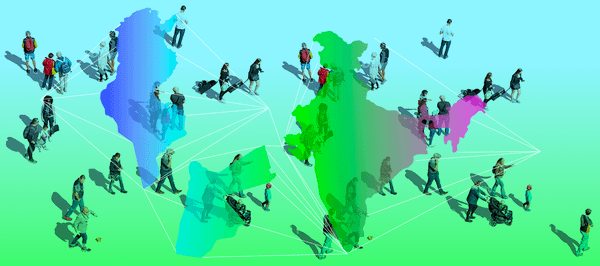
The goal isn't diversity as a headcount exercise. It is increasing the variety of perspectives, experiences, sectors, disciplines, and career stages represented in the conversations we have. And this is actually where network science offers another useful idea. Granovetter's classic work on the strength of weak ties showed why connections outside our closest social circles can be particularly important for connecting otherwise separate networks and allowing information and opportunities to travel between them (Granovetter, 1973).
For a local behavioral science community, these kinds of bridges are particularly valuable because they allow the community to expand beyond the networks that already exist within it. This is the value of the weak ties Granovetter (1973) described: they create connections between social groups that might otherwise remain relatively separate.
Thinking about growth
This is also why we have come to think about growth less in terms of how many people attend any individual event and more in terms of whether we are gradually widening the network itself. If the same twenty people attend every event, we may have a very engaged group, but we are not necessarily creating new connections across Philadelphia’s broader academic and professional communities.
By contrast, a handful of newcomers from different universities, organizations, or disciplines may have an impact that is less immediately visible in attendance numbers but much more important to the longer-term development of the chapter. Each creates another potential pathway into a community that previously may have been difficult to find.
We saw a small example of this at a recent Bescy Philadelphia Stammtisch. A newcomer to the group, and a recent graduate, brought a friend along so they wouldn’t have to attend alone. The friend was quick to clarify that they were not a “behavioral scientist”, they were simply there for moral support. But as the evening went on, they became part of one of the more interesting conversations at the table, talking about how radio, music discovery, and popularity have changed with the rise of social media and the ways artists and songs now gain traction. What began as a conversation seemingly outside the traditional boundaries of behavioral science quickly became a conversation about social influence, attention, norms, algorithms, and how environments shape what people encounter and ultimately choose. That is exactly the kind of boundary we hope to make more permeable. Behavioral science does not only belong to people who call themselves behavioral scientists, and some of the most interesting perspectives may come from people who initially assume they have little reason to be at the table.
Creating those pathways, however, does not guarantee that people will use them. Someone can discover Bescy, decide to attend an event, and still arrive wondering whether the group is really meant for them. In fact, expanding a network makes that question particularly important. The people we most want to reach are often, by definition, the people who are least likely to already know someone in the room.
They may be coming from a university that has not historically been represented, from an industry where “behavioral scientist” is not a common job title, or from a discipline that sits somewhere at the edges of behavioral science. Their first experience of the community therefore matters, not simply whether they attend, but whether that experience gives them a reason to return.
Getting someone through the door is an important first step, but that brings us to another part of the behavioral science of community building that we have been thinking about: belonging.
Research on social belonging demonstrates that people's interpretations of social environments matter. Walton and Cohen's work, for example, showed how uncertainty about belonging can shape how people interpret everyday experiences and how relatively small interventions targeting those interpretations can produce meaningful downstream effects (Walton & Cohen, 2011).
A professional community isn't a university classroom, and we shouldn't assume findings transfer wholesale across contexts. But the broader lesson is worth considering: people are constantly reading environments for evidence about whether they fit.
Who is speaking?
Who seems to know one another?
What kinds of jobs do people have?
What language do they use?
Is everyone more senior than me?
Is everyone a student?
Does everyone seem to have a PhD?
Am I supposed to already understand the terminology?
Would anyone notice if I came back?
Community design isn't only about access; it’s about creating visible evidence of belonging. That is one reason we want Bescy Philadelphia to contain a mix of students, academics, established behavioral scientists, curious newcomers, and industry practitioners. Diversity itself becomes information about the boundaries of the community.
It tells people there is more than one way to belong. And, ultimately, that sense of belonging matters because our goal is not simply to get someone through the door once. A well-attended event can certainly feel like a success, but a single evening with a large turnout does not necessarily tell us whether we are building a community.
What interests us more is what happens afterward: whether someone who took a chance on their first Stammtisch feels comfortable coming to the next one, whether they begin to recognize familiar faces, whether conversations continue between events, or whether they eventually bring a friend or colleague of their own.
In behavioral terms, the interesting transition is not simply from non-attendance to attendance, but from attending once to returning, and eventually to becoming someone who sees participation in the community as something they simply do.
Gollwitzer's work on implementation intentions, for example, shows how connecting an intended behavior with a specific situational cue, an "if X, then I will Y" plan, can make goal-directed action more likely (Gollwitzer, 1999).
Over time, those repeated interactions can also begin to extend beyond the events themselves. Conversations continue, papers and ideas are shared, introductions are made, and people begin bringing others into the group. At that point, engagement is no longer being generated entirely by the chapter or its organizers; some of it begins to emerge from the relationships developing within the community itself.
Over time, attending requires less deliberation. And importantly, relationships begin to exist between events. Someone follows up on a conversation. Someone shares a paper. Someone introduces two people. Someone hears about a job opportunity. Someone suggests the topic for the next gathering.
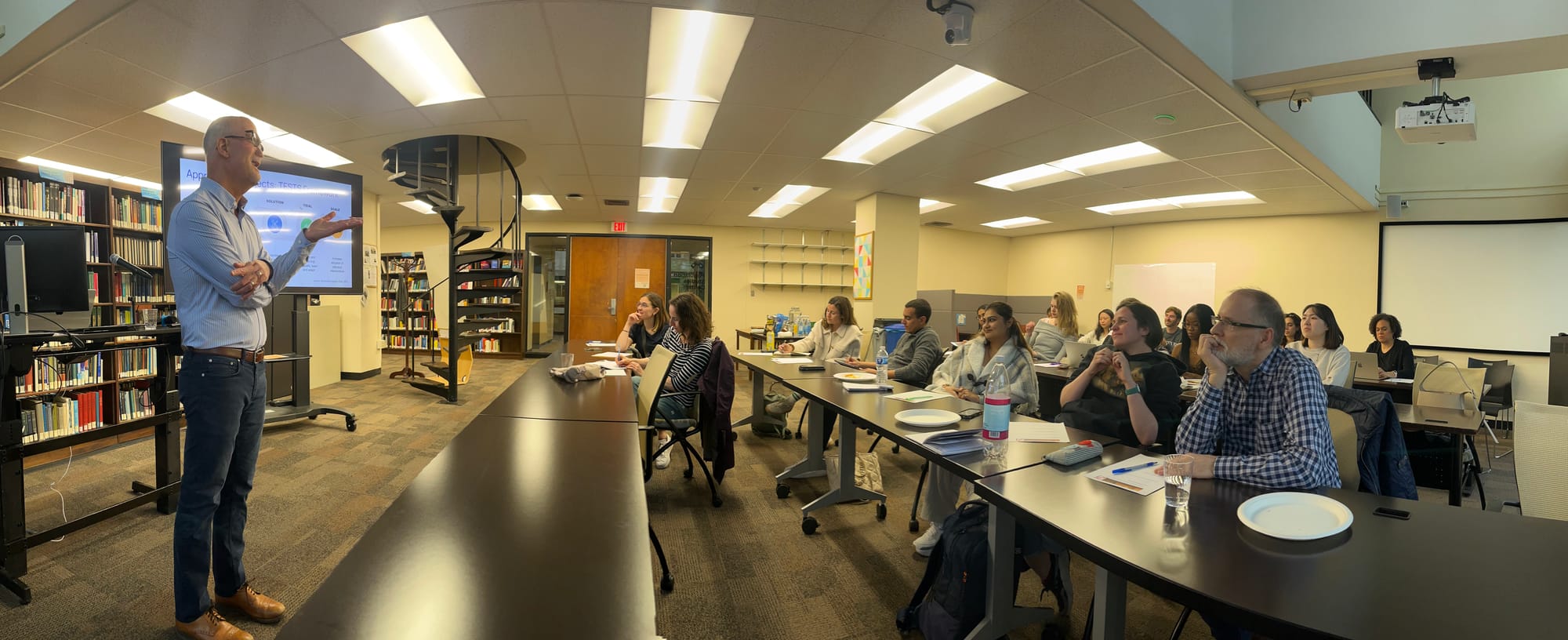
Growing our community in Philly and beyond
We are still very much figuring out how to encourage that process. There is no five-year master plan for what the Philadelphia chapter should look like, nor do we assume that we already know the best way to grow it. Instead, we have been approaching growth with some of the same curiosity we bring to behavioral science more generally. We have ideas about what might work and why: recurring informal gatherings may make participation feel easier over time; connections with other universities may help us reach students outside our existing networks; events built around applied problems may make the community more relevant to practitioners; and having different kinds of events may give people with different interests and comfort levels more ways to participate. But these are ideas to explore rather than a formula we expect the community to follow.
So we are trying different things and paying attention to what happens. Some events attract mostly familiar faces, while others bring people into the group whom we have never met before.
There is a temptation in organizational growth to look for the intervention that will produce a visible change quickly. Community building may be particularly poorly suited to that mindset. Relationships take time to develop, and the effects of making one new connection are not always immediately apparent. A student from another university may eventually bring classmates. A practitioner may connect the group with colleagues in an industry we have not reached before. People who initially arrive knowing no one begin to recognize familiar faces, and eventually they may become the familiar face that makes someone else's first experience easier.
For us, that makes slow growth not simply something we are tolerating while we wait for the chapter to become bigger, but an important part of how we hope it becomes broader. We may never have a single event that marks the moment when Bescy Philadelphia has successfully “grown.” A more meaningful indication may be much quieter: looking around at a Stammtisch one evening and realizing that the people around the table no longer all arrived through the same university, profession, discipline, or social network.
There is also a broader lesson in this experience that extends beyond Philadelphia. As behavioral scientists, we spend a great deal of time helping other people and organizations understand behavior. We study why people fail to act on their intentions, how friction affects participation, how social environments influence behavior, how networks form, and how experiences shape what people choose to do next.
Yet we do not always apply that same lens to the communities and institutions we build ourselves. Perhaps that should not be surprising. Behavioral scientists are subject to the same constraints we study in everyone else: limited time and attention, competing demands, and the tendency for immediate concerns to capture our bandwidth (Mullainathan & Shafir, 2013). Running a professional community often means solving the immediate problem (finding a speaker, securing a venue, getting the invitation out) rather than stepping back to consider the behavioral environment we are creating. In that sense, our failure to consistently “behavioral science” ourselves may itself be a behavioral science problem.
Professional organizations are behavioral environments too. The way we structure events, communicate who they are for, choose where they are held, welcome newcomers, and create opportunities for people to interact all shapes who participates and who returns. They also send signals (sometimes intentionally and sometimes not) about what it means to belong.
That has probably been the most useful shift in how we think about growing Bescy Philadelphia. Rather than asking only how we can attract more people, we are increasingly interested in how someone finds their way in, what makes that first interaction comfortable or uncomfortable, what connects them to someone they would not otherwise have met, and what makes them want to return.
It is a slower and less easily measured approach to growth, but it also feels appropriate for a behavioral science organization. We are paying attention to the behavior happening within our own community and allowing what we learn to shape what we do next.
References:
Granovetter, M. S. (1973). The strength of weak ties. American Journal of Sociology, 78(6), 1360–1380. https://doi.org/10.1086/225469
Kagan, B. J., Kitchen, A. C., Tran, N. T., et al. (2022). In vitro neurons learn and exhibit sentience when embodied in a simulated game-world. Neuron, 110(23), 3952–3969. https://doi.org/10.1016/j.neuron.2022.09.001
McPherson, M., Smith-Lovin, L., & Cook, J. M. (2001). Birds of a feather: Homophily in social networks. Annual Review of Sociology, 27, 415–444. https://doi.org/10.1146/annurev.soc.27.1.415
Shah, A. K., Mullainathan, S., & Shafir, E. (2012). Some consequences of having too little. Science, 338(6107), 682-685. https://doi.org/10.1126/science.1222426
Shahab, S., & Lades, L. K. (2024). Sludge and transaction costs. Behavioural Public Policy, 8(2), 327–348. https://doi.org/10.1017/bpp.2021.12
Sheeran, P., & Webb, T. L. (2016). The intention–behavior gap. Social and Personality Psychology Compass, 10(9), 503–518. https://doi.org/10.1111/spc3.12265
Walton, G. M., & Cohen, G. L. (2011). A brief social-belonging intervention improves academic and health outcomes of minority students. Science, 331(6023), 1447–1451. https://doi.org/10.1126/science.1198364
Wikipedia contributors. (2025, December 4). Stammtisch. In Wikipedia. https://en.wikipedia.org/wiki/Stammtisch
Zajonc, R. B. (1968). Attitudinal effects of mere exposure. Journal of Personality and Social Psychology, 9(2, Pt. 2), 1–27. https://doi.org/10.1037/h0025848