Scaling a Behavioral Lens
As behavioral scientists conducting user research, we bring a perspective that focuses research on driving the outcomes that matter most. We understand what influences judgment, decisions, and behavior change, helping us zoom in on what truly drives results while filtering out misleading signals.
This behavioral lens (Hallsworth, 2023; Young, 2024) helps us optimize research methods, draw more robust conclusions from our findings, and drive implementation of our recommendations. The result is user research that delivers on its core promise to inform decisions that create measurable product and business impact.
A behavioral science perspective has been so beneficial to our own practice that we decided to share the approach. To date, we've trained hundreds of research, design, and product professionals at a financial services company to apply a behavioral lens to user research. These training participants either conduct research themselves or frequently help shape and consume the research of cross-functional collaborators.
This behavioral approach generated $4 million in annual revenue.
The response has exceeded expectations. Senior researchers reported fundamental improvements in how they design interviews and synthesize insights. Product managers shifted to more nuanced interpretations of user quotes and saw value in a broader range of research questions. Surprisingly, our impact even reached well beyond the intended audience. Financial advisors, who work outside the product realm, requested our materials for additional perspective on what influences client decisions.
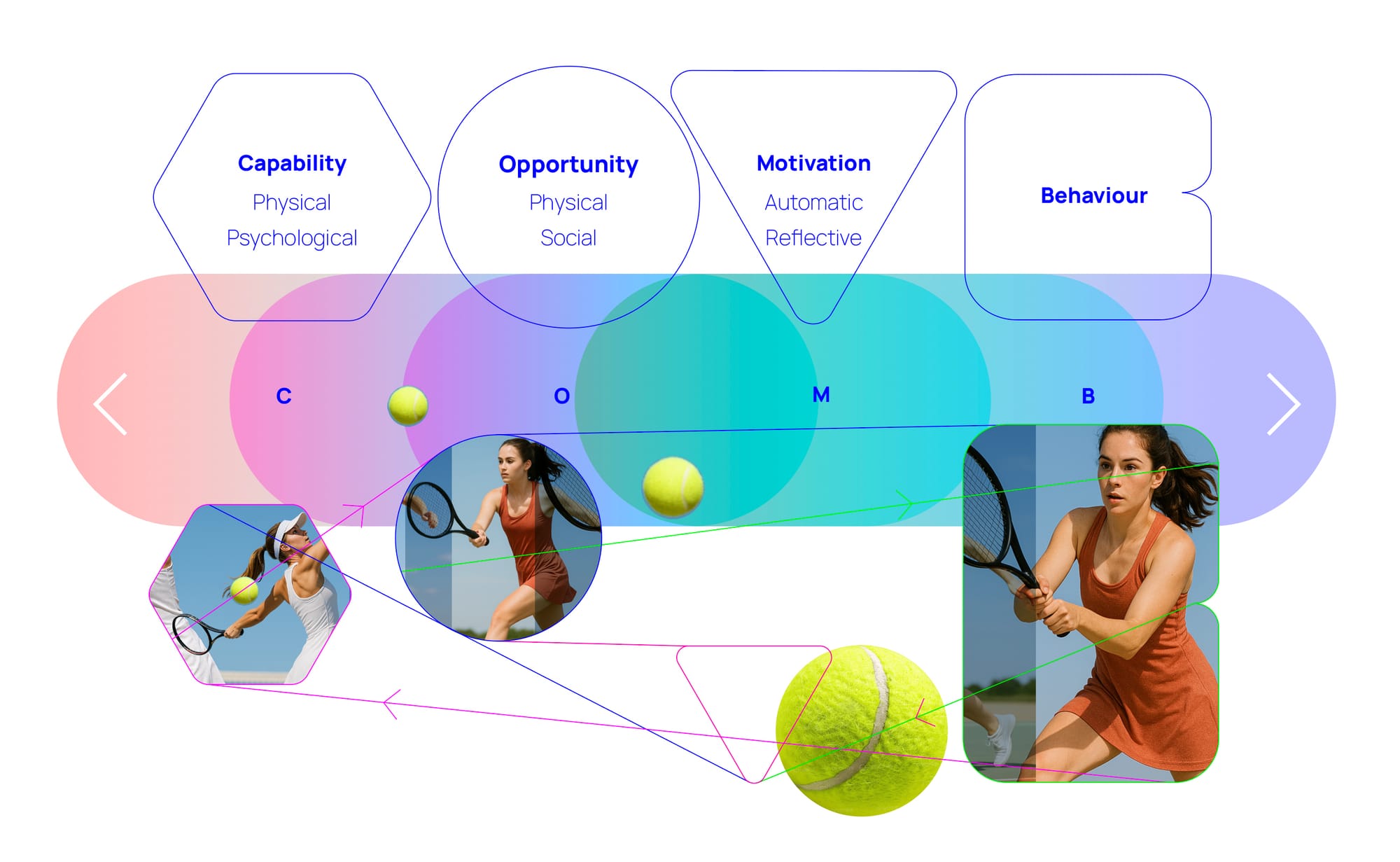
Naturally, we couldn't subject all our colleagues to years of intensive coursework. Instead, we focused on a few practical, intuitive basics. We trained participants to apply the evidence-based COM-B framework, which unpacks influences on behavior (Michie et al., 2014; Wendel et al., 2025). This framework is simple enough for beginners yet sophisticated enough to grow with them. As participants build behavioral science expertise, they can layer in increasingly nuanced insights. We taught participants to leverage the framework within their existing user research practice to address common limitations and challenges. In product development, where time is everything, a behavioral lens must strengthen existing processes, not slow teams down.
A Behavioral Lens Across Research Phases
We trained participants to leverage a behavioral lens throughout the user research process, just like we do. This amplifies the value of research by zooming in on influences that drive measurable changes in key outcomes.
Our trainings for product teams focused on defining objectives, which directly relates to their role. Researchers and designers learned to apply the behavioral lens across all phases of the research process, outlined below:
Defining Objectives
We taught participants to apply a behavioral lens from the start of research to focus on what matters most.
First, identify a measurable outcome that reflects your strategic priorities. This outcome should matter to your stakeholders, and while it will often be a business outcome, it can also include goals such as increasing product revenue or reducing patient symptoms. Next, identify a target behavior that could meaningfully influence that outcome, such as signing up for a subscription or taking medication as prescribed. Always ensure that the target behavior aligns with users' best interests. At times, you may begin a project without enough information to determine the appropriate behavior to target. In that case, identifying promising behaviors becomes a preliminary research objective.
With this behavioral lens, your research question becomes clear: “How can that target behavior be changed?”
Case Study: In a previous role, Aileen led research for a dual-sided marketplace that offered financial bonuses for client referrals. Stakeholders initially wanted to know how much to increase the bonus to boost referrals, but applying a behavioral lens reframed the entire approach.
First, Aileen identified the measurable outcome that truly mattered: revenue from referrals, rather than referral volume. Low-value referrals actually hurt the business by creating bottlenecks without generating meaningful revenue. Next, she needed to identify which target behavior would most effectively drive that outcome. After confirming that stakeholders were open to alternatives beyond raising bonuses, the research objective became clear: “How can we increase referrals that generate revenue?”
Research revealed that high-value referrers were motivated by building trusted professional connections, not earning bonuses. In fact, some even avoided the bonus to protect their credibility. Based on these findings, the team enhanced the connection-building aspects of the referral experience instead of simply increasing financial incentives. This behavioral approach generated $4 million in annual revenue.
Designing Research Plans
Participants were taught how to apply a behavioral lens to optimize research methods and plans, helping them avoid pitfalls and uncover what matters most.This approach highlights each method’s strengths and limitations, including their potential biases. This enables one to select the right combination of methods for generating accurate insights. While behavioral science is known for experimentation, such as A/B testing—and we have found experiments invaluable for evaluating solutions—experiments alone cannot address all research needs. There are other methods better suited for goals such as developing a foundational understanding of users early in the product development life cycle.
A behavioral lens also optimizes how you use each method. Our trainings focused on qualitative interviews, a cornerstone of user research that is valuable but can be risky when used incorrectly. We frequently hear about situations where users confidently describe what they want, teams build the solution users requested, and the result goes unused.
A behavioral lens can be leveraged to avoid this outcome. It highlights which questions to avoid asking because users cannot answer them accurately. It also guides you toward questions users can actually answer, and towards better ways to phrase those questions. Asking a user, "Tell me about the last time you faced this problem," rather than "Would you use this feature?" can be the difference between building an effective solution to a problem and building a feature nobody needs.
This perspective helps generate evidence-based hypotheses about what drives or hinders user behaviors. You can then design interview guides that examine these hypotheses. Behavioral frameworks like COM-B, which we used in our trainings, ensure that you probe for powerful influences on behavior that users—and even researchers—often overlook.
Case Study (continued): The dual-sided marketplace research used mixed methods to uncover what truly drove referrals. Behavioral metrics revealed patterns across many users, and suggested where to dig deeper. Qualitative interviews provided rich context about specific referral moments. Rather than asking users to generalize about their behavior, we focused on actual events and probed for influences that users often overlook.
The user interviews, strengthened by a behavioral lens, proved essential. Metrics analysis alone would not have uncovered that some users used workarounds to actively avoid receiving the referral bonus, because being paid felt uncomfortable when their real motivation was helping others access a valuable resource.
Developing Synthesis
We also taught participants how a behavioral lens transforms research synthesis. Without it, teams often misinterpret user feedback and overlook the factors that actually drive behavior.
This lens helps you unpack findings more effectively, so you can understand when to take responses at face value, when to dig for underlying needs, and when certain answers may be misleading. For instance, when users say they like a design in front of its creator, it doesn’t necessarily mean they’ll use it.
User researchers often bring together findings from multiple sources or research methods to develop richer insights and a more complete picture. A behavioral perspective plays a similar role by placing your findings in the context of established behavioral research, helping you develop hypotheses about what your findings mean and why they matter. It also sharpens your ability to identify critical barriers and drivers that might otherwise go unnoticed. For instance, knowing that small frictions can derail entire user journeys prompts you to pay attention to seemingly minor obstacles at crucial moments that may have outsized impact.
This approach strengthens your deliverables. Journey maps become more than simple process flows—they begin to reveal behavioral barriers. Personas move beyond demographics to focus on the capabilities, opportunities, and motivations that drive action. Ultimately, you produce insights that don’t just describe what users do, but also point to why they do it and how their behavior can be influenced.
Case Study (continued): When synthesizing findings from the dual-sided marketplace research, applying this behavioral lens zoomed in on information about interpersonal relationships and cultural norms, which can be powerful behavioral influences.
As patterns emerged, the behavioral perspective led to the synthesis of two referrer personas based on distinct behaviors, social contexts, and motivations rather than demographics or superficial characteristics. This revealed that the type of referrers who generated high-value clients weren't primarily motivated by the bonus but had other reasons for referring. Equipped with this insight, the team designed solutions that served these referrers' actual needs rather than simply increasing financial incentives.
Driving Impact
Finally, our trainings emphasized the practical value of this behavioral lens. User research isn’t about understanding for its own sake, but about driving product and business impact. A behavioral lens helps ensure your research connects directly to the outcomes that matter. It also sharpens how you unpack what drives behavior, leading to smarter solutioning.
However, insights alone don't change products—you still need stakeholder buy-in. Luckily, focusing research on driving an important business outcome and aligning on objectives at the outset are strong first steps toward building stakeholder support. A behavioral lens also serves as a reminder that stakeholders are people too. Approaching cross-functional collaboration with this perspective helps you address partners’ needs alongside users’ needs. And ultimately, it increases the likelihood that your insights will be implemented.
Case Study (continued): The dual-sided marketplace research focused squarely on increasing high-value referrals, and succeeded, ultimately driving a solution that generated $4 million in annual revenue. But success required more than strong insights. It wouldn’t have been possible without cross-functional partners. One product manager in particular remained deeply involved throughout the research process and strongly advocated for implementing the research-based recommendations. Without that collaboration and support, the insights would not have gained traction.
What We Learned
Before providing these training sessions at a financial services company, we knew a behavioral lens strengthened our own user research but were unsure whether others would embrace it. We had led successful trainings in the past, and Aileen had built behavioral capabilities from the ground up at other organizations. Yet we had also heard many accounts of behavioral science initiatives ending in frustration. Designers abandoned overly complex frameworks that didn't fit their workflows. Product managers halted behavioral testing when it slowed their ability to ship. User researchers began with long lists of biases and heuristics, only to set them aside when product decisions raced ahead without them. In each case, behavioral science became a burden that slowed teams down rather than a tool that sharpened their work.
We applied a behavioral lens to designing the training itself. We demonstrated how behavioral science improves outcomes, but more importantly, we taught participants how to apply it within realistic constraints, where additional burden, time, or stakeholder friction can derail new approaches.
We prioritized simplicity and ease of application (Hallsworth, 2025), focusing on a few key elements from the evidence-based COM-B framework (Michie et al., 2014). Participants also learned how to use a behavioral lens to enhance their current workflows, not overhaul them. No additional resources were required. No team norms were disrupted. Just practical enhancements they could implement immediately. We also highlighted how a behavioral lens could address some of their common pain points, making their day-to-day work easier rather than adding burden. This approach transformed behavioral science from an interesting concept into something teams could actually use.
We learned that people adopt behavioral science when it enhances, rather than overwhelms or overcomplicates, their existing processes. And widespread adoption enables behavioral science to achieve its full potential, amplifying the value of user research at scale to drive the outcomes that actually matter.
Acknowledgement
We would like to thank Nicole Grabel for her contributions to this work.
References
Hallsworth, M. (2023). A manifesto for applying behavioural science. Nature Human Behaviour, 7(3), 310-322.Hallsworth, M. (2025, May 4). Why simplicity can be strength in a complex world. Behavioral Scientist. https://behavioralscientist.org/why-simplicity-can-be-strength-in-a-complex-world/
Michie, S., Atkins, L., & West, R. (2014). The behaviour change wheel: A guide to designing interventions. Silverback Publishing.Wendel, S., Khan, Z., & Artavia-Mora, L. (2025). A review of behavioral frameworks: Taking an end-to-end systematic approach to applied behavioral science. Bescy Magazine. https://magazine.bescy.org/articles/a-review-of-behavioral-frameworks/
Young, S. (2024). Bridging the divide between the potential & practice of behavioral science in the private sector. Behavioral Science & Policy, 10(1), 19-25.