What does “behavioral systems” mean, why is it relevant, and how do the behavioral sciences and systems thinking add to one another?
In Bescy’s Behavioral Systems group relaunch event, Dr. Steve Wendel (applied Behavioral Scientist, founder of sistemaFutura, and former Vice-President of Busara) welcomed Ruth Schmidt (Associate Professor of Behavioral Design at IIT Institute of Design) for a conversation about a new subfield: behavioral systems.
What does “behavioral systems” mean, why is it relevant, and how do the behavioral sciences and systems thinking add to one another? Schmidt answers these questions through her paper Choice Posture, Architecture, and Infrastructure: Systemic Behavioral Design for Public Health Policy, co-authored with Veronica Soldan and Zeya Chen. Their paper introduces the Choice Triad model, which expands the concept of choice architecture to include choice infrastructure (a set of rules and norms) and choice posture (the human attitudes shaped by the system).
Introduction: Why integrate behavioral science and systems thinking, and what exactly is “behavioral systems”?
While applied behavioral science has been successful in creating targeted, cost-effective interventions, it struggles to address larger, more complex societal issues. These issues are not products of isolated individual decisions, but are embedded in intricate systems.
Schmidt's experience bringing her design expertise to the fields of healthcare, education, and financial services is inherently systemic, redefining how we understand an intervention targeting a single behavior.
She defines a system as something "beyond an individual" composed of interacting component parts. The focus is on complex systems, where solving one problem can have implications for another and change it. Wendel added that interaction generates behavior that is different from what one might expect from simply looking at individual parts.
Wendel also connected some systems properties with known challenges within behavioral science.
While a “systems thinker” thinks in terms of broader effects—the effects on other people and large-scale behaviors—a behavioral scientist understands them as spillover effects of an intervention. A systems view forces practitioners to consider the dynamic, long-term reactions to interventions.
The Choice Triad Model: A Framework for Synthesis
To ground these concepts, Ruth Schmidt presents the Choice Triad model, which offers a structured way to combine behavioral science, systems, and human-centered design. It posits that a comprehensive understanding of behavior requires analyzing three interconnected elements.
The first element is choice architecture, traditionally the domain of applied behavioral science, and it focuses on the design of the immediate context in which a decision is made to influence a specific behavior. Schmidt expands her model with the addition of Choice infrastructure and Choice posture.
Choice infrastructure introduces the systemic perspective, focusing on the broader, often implicit, conditions that shape and constrain decisions. While not necessarily connected to a specific behavior, it has a profound if indirect impact on how people decide—think organizational hierarchies, access (or lack thereof) to digital systems, rules, cultural norms, and social environments.
Choice posture provides the human-centered design perspective, focusing on an individual's internal state, attitudes, and predispositions that affect which options are considered in the first place. This posture is not static, and is often cultivated and shaped over time by choice infrastructure.
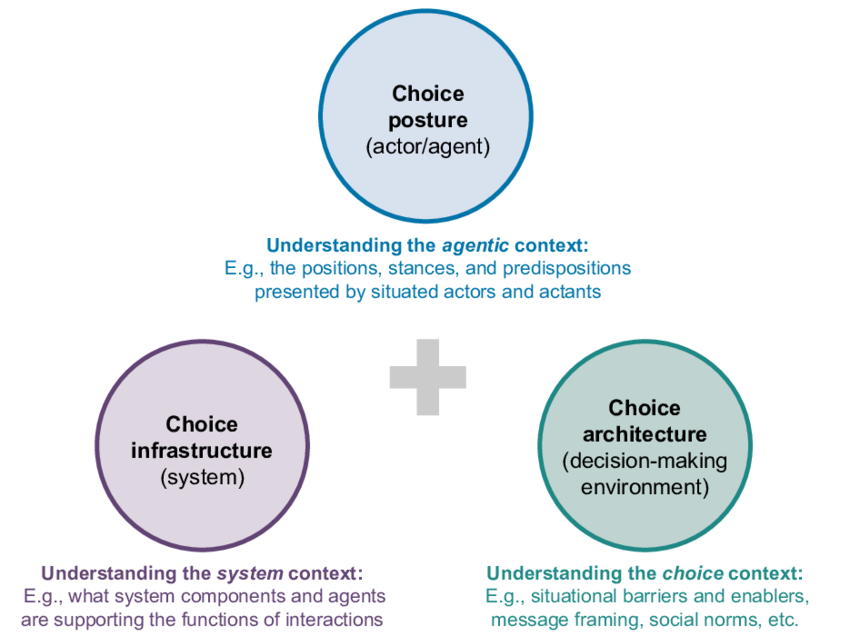
For example, consider how the Choice Triad model might describe the conditions surrounding a public health crisis like the COVID-19 pandemic:
- Choice infrastructure: The systems for vaccine distribution, school closures, and information dissemination played a major role in the public’s reaction. Reliance on digital sign-up systems, for instance, created barriers for those without internet access.
- Choice posture: There were widely varied public postures, including fear of infection, skepticism toward vaccines, and trust or distrust in public health authorities.
- Choice architecture: The framed message of "social distancing" (which was criticized for its negative connotations) or the campaigns that reinforce social norms such as wearing masks in public spaces and vaccination.
Final Reflections on the Field
Concluding remarks included reflections on how to integrate different fields to address complex social problems. Integrating systems thinking fundamentally transforms the nature of a behavioral scientist's work, creating new opportunities and challenges.
"I think it's more about how, in many situations, we benefit from different perspectives. If we only adopt one choice stance—the perspective—we'll miss all the amazing data and evidence we have about behavior. If we only look at systems (...) we'll forget their impact on people (...) We can design better if we bring these perspectives together."
—Ruth Schmidt
Moreover, the job opportunities for future generations in the field relate to more strategic roles that involve analyzing entire systems, designing a better organization, or a set of choice conditions. The value lies in using behavioral knowledge to understand and improve the very infrastructure of choice.
Want to know more? Watch the entire seminar here.
Bescy's next Behavioral Systems webinar will be Behavioral System Mapping in Practice with Kai Bellmann, PhD Researcher at Delft University of Technology, on February 26. Register here.
References
Schmidt, R., Chen, Z., & Soldan, V. P. (2022). Choice posture, architecture, and infrastructure: systemic behavioral Design for Public Health Policy. She Ji: The Journal of Design, Economics, and Innovation, 8(4), 504-525.